
Pharma leaders say India must now move from generics to innovation
Sun Pharma, Biocon and Glenmark chiefs point to China’s rapid rise in innovative drugs, say India must invest in new drugs now
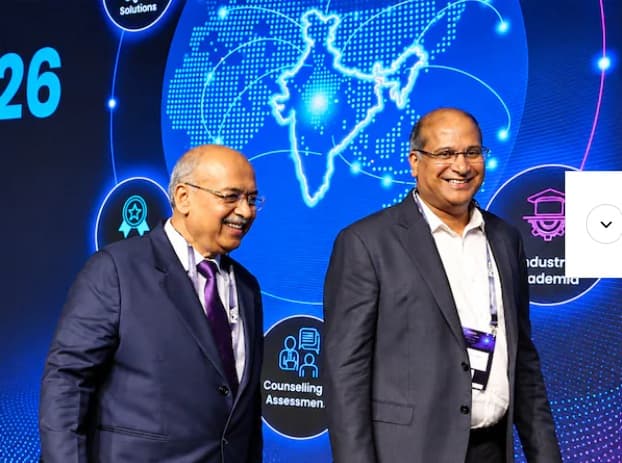
The country’s pharmaceutical industry has grown big enough to shift from low-cost generics to developing new drugs, said three of the country’s major pharma companies, pointing to China’s rapid shift up the value chain as evidence that such a transition is possible.
Speaking on a panel at an event in New Delhi, Dilip Shanghvi of Sun Pharmaceutical, Glenn Saldanha of Glenmark Pharmaceuticals and Kiran Mazumdar-Shaw of Biocon argued that India’s generics success is the foundation for the next stage.
“The Indian industry has reached a size where we can invest in innovation,” Shanghvi said at IFQM Symposium 2026.
The domestic pharma market is valued at about $60 billion and is projected to more than double to $130 billion by 2030. According to the Economic Survey 2025-26, pharmaceutical turnover reached Rs 4.72 lakh crore in fiscal 2025.
“If we have to become big globally, then we must focus on innovation... It’s necessary for the country to achieve the Viksit Bharat goal by 2047,” said Shanghvi, Executive Chairman of Sun Pharma.
India is the world’s largest supplier of generic medicines, accounting for roughly one-fifth of global supply.
“The next decade is very important for India to move from being the pharmacy of the world in terms of generic medicines to become an innovation-led country,” said Glenn Saldanha, Chairman & Managing Director of Glenmark Pharma, adding that China “pretty much pivoted” in the last 20 years and that now it’s India’s turn.
“And I think the industry is pretty well-positioned in this next decade to make those transformational steps.”
Mazumdar-Shaw, Executive Chairperson, Biocon and Syngene International, also said India should look at China’s example. “The way they [China] did it was to have a very strategic focus on what it takes, to innovate and build credibility,” she said. China also allowed “very accelerated processes” for early-stage molecules, she said, adding that India should do that too.
“We have to get to where China is today, and I think we can do it. What we need is to create that credible policy-led ecosystem.”
Mazumdar-Shaw said this is the time to take a deep dive into what regulatory reforms can be done fast and that she sees the regulatory system starting to respond. “I’m also seeing a positive response from the regulatory system as well,” she said, adding that India should look beyond China for models. “There are many, many models that we need to look at in terms of emulating what other countries have done, not just China, but what Australia has done.”
On the obstacles, she said the basic problem in India is risk aversion. Biocon often prefers to run clinical trials abroad because doing them in India is “tedious”, she said. “People want to do it with absolutely no adverse events, which is not possible.”
Saldanha described India’s pharma sector as a mix of companies at different stages. Some are focused on scale in generics, others mix generics and biosimilars, and “a handful” are pushing toward innovation. For the last group, he said, “The whole idea is to move as rapidly as possible to having more differentiated innovative products”. He expects a lot of activity over the next five to 10 years.
Mazumdar-Shaw stressed continuity. “The pipeline is the lifeline,” she said, arguing that innovation spending can’t be a one-off.
Shanghvi said Sun’s acquisition of Organon gives it the ability to register products within about three years of a first-market launch, and would lift innovative products’ share of Sun’s business from about 22 percent to about 30 percent.
“In markets such as Europe, China, Korea, Taiwan, Australia and Turkey, we have no ability to launch the product ourselves,” he said. Sun also lost time in countries such as Brazil and Mexico because it lacked infrastructure there, he said.
He urged Indian industry to be patient. “The investment in innovation will produce a return only after a few years,” he said, adding that the government’s recent schemes should accelerate the transition.
Related News

Role of Nutraceuticals in Cardiology Practice
September 12, 2026
44-year-old gastroenterologist shares ‘anti-ageing secrets’ he wishes he knew in his 20s: ‘Sleep is best longevity tool’
September 11, 2026